Tungsten carbide is one of the hardest engineered materials in industry, yet it does not exist as a ready-made metal you can simply cut and shape. Finished carbide components have to be built up from raw materials.
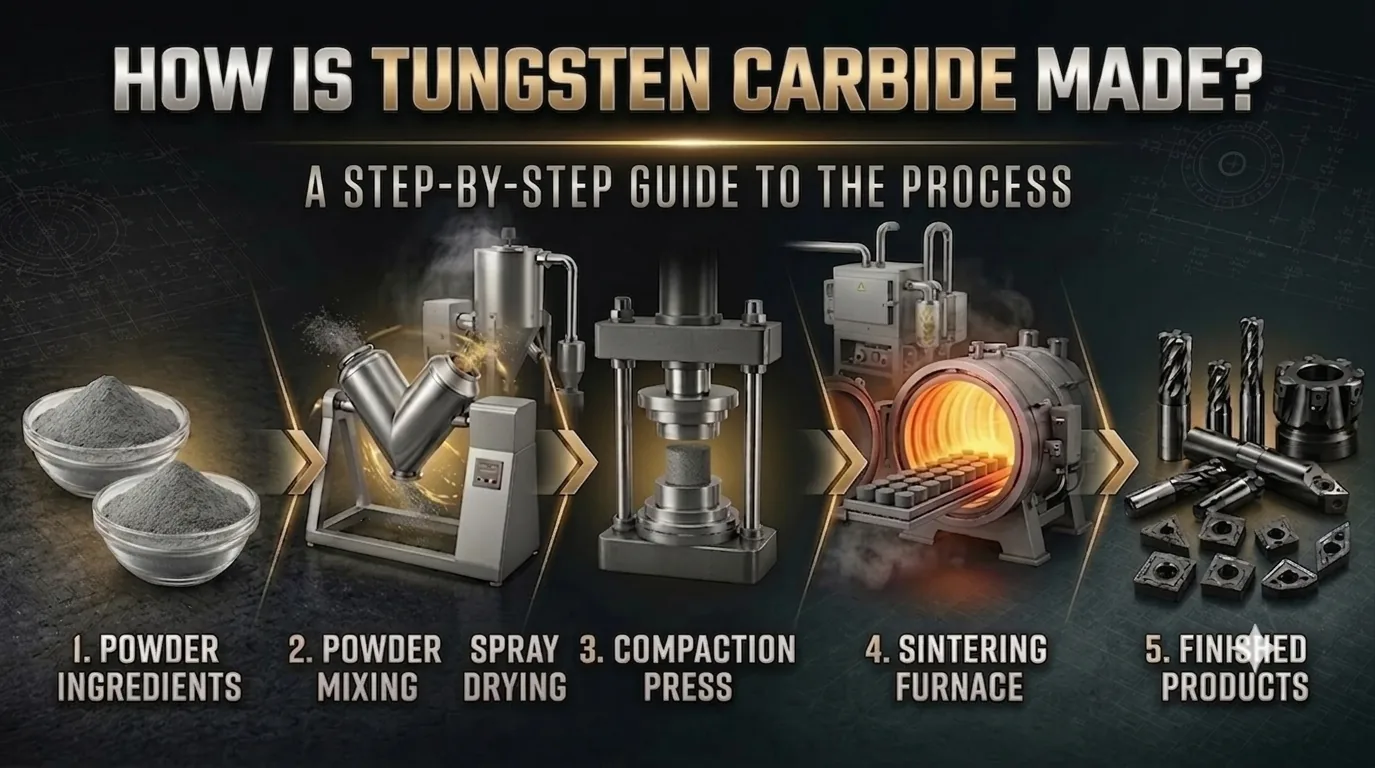
So how is tungsten carbide made? In short, the tungsten carbide manufacturing process is a form of powder metallurgy that converts raw materials, fine tungsten carbide powder and a metallic binder, into finished, solid carbide components. The powder is blended with the binder, usually cobalt, then milled, granulated, pressed to shape, dewaxed and sintered at high temperature until it fuses into a dense, extremely hard solid part.
This same cemented carbide manufacturing route is used for tungsten carbide production worldwide, often shortened to WC manufacturing. This guide walks through every stage of the powder metallurgy process, from raw material to finished component, and explains why each one matters.
What Is Tungsten Carbide?
Tungsten carbide (chemical formula WC) is a compound of tungsten and carbon. On its own it is hard but very brittle, so it is almost never used pure. Instead it is combined with a tough metallic binder to create what engineers call cemented carbide, or hard metal: a composite of hard tungsten carbide grains held together by a softer, tougher metal such as cobalt. This pairing is what gives finished carbide parts their rare mix of extreme hardness and usable toughness.
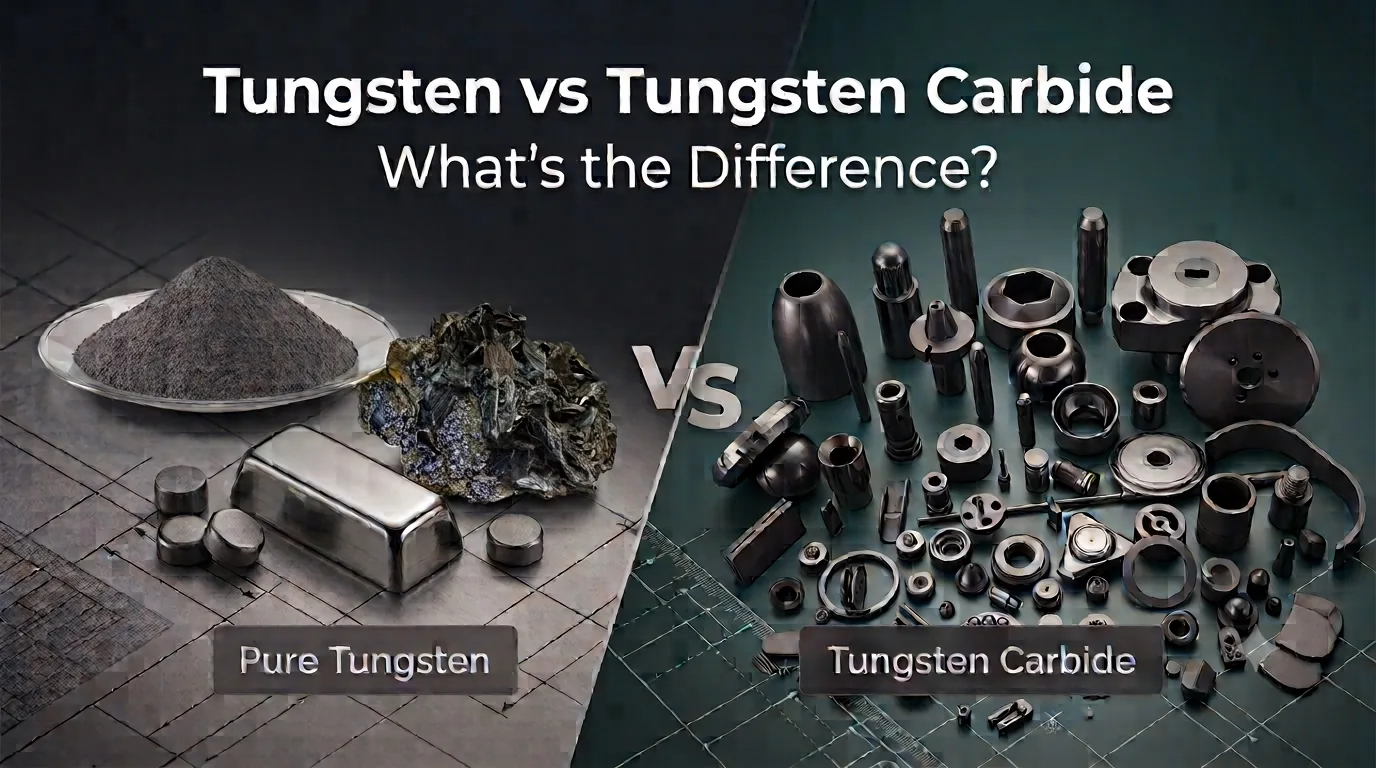
For a fuller comparison of the raw metal and the compound, see our guide to tungsten versus tungsten carbide. The rest of this article focuses on how the compound is turned into real components.
The Raw Materials
Two ingredients define almost every property of the finished part:
- Tungsten carbide powder, the hard phase. Its average grain size, from sub-micron up to coarse grades, sets how hard and wear resistant the final part will be.
- A metallic binder, usually cobalt, sometimes nickel for corrosion resistance. The amount of binder, typically between 6 and 25 percent, controls how tough and shock resistant the part is.
Changing the grain size and the binder percentage is how a manufacturer tunes a grade for a specific job, and it is why grade selection matters so much. Small grains and low binder give maximum hardness for cutting and wear; larger grains and more binder give the toughness needed for impact and mining tools.
Step 1: Producing Tungsten Carbide Powder
The process begins with pure tungsten metal powder, which is mixed with fine carbon, usually carbon black, and heated in a furnace under a carefully controlled atmosphere. This carburising step forces the tungsten and carbon to react and form tungsten carbide (WC). The result is a grey tungsten carbide powder whose grain size is controlled at this stage, because it largely determines the performance of every part made from it.
Step 2: Blending and Ball Milling
The tungsten carbide powder is then wet-milled together with the cobalt binder, usually in a ball mill with a liquid such as alcohol. Ball milling does several things at once: it breaks down agglomerates, coats every carbide grain evenly with binder, and mixes in small amounts of grain-growth inhibitors that stop the grains coarsening later.
At this powder-preparation stage a temporary pressing binder, or lubricant, such as polyethylene glycol (PEG), wax or an equivalent, is also added to the slurry. This temporary binder gives the powder the cohesion it needs to hold a pressed shape later, and is removed again during dewaxing before sintering.
Getting this blend uniform is critical, because any unevenness here shows up as weak spots in the finished component. The result is a fine, uniform milled slurry ready for drying.
Step 3: Drying and Granulation
After milling, the carbide slurry needs to be dried before it can be pressed. There are two commonly used drying methods: spray drying and tray drying.
Spray drying is widely used for high-volume production. The milled slurry is sprayed into a heated drying chamber, where the liquid evaporates quickly and forms small, rounded, free-flowing granules. These granules flow easily into the pressing die and help provide uniform filling and consistent green density.
Tray drying is another method, often used for smaller batches, development work or certain powder formulations. In this method, the milled slurry is spread in trays and dried under controlled temperature and airflow. Once the material is dry, it is removed from the trays and may be sieved or granulated to obtain a suitable particle size for pressing.
Both methods remove the milling liquid and prepare the powder for pressing. The choice between spray drying and tray drying depends on factors such as production volume, powder formulation, equipment and the required granule characteristics. Proper drying and granulation are important because poor powder flow or uneven granule size can lead to inconsistent die filling, density variation and dimensional problems during sintering.
Step 4: Pressing the Powder to Shape
The granulated powder is compacted into a green part, so called because it is fragile and not yet sintered. Carbide pressing is done in several ways depending on the shape and quantity: rigid die pressing for simple, high-volume parts; cold isostatic pressing for larger or more uniform blanks; and extrusion for long rods. The green part is held together only by pressure and a temporary binder, so it has roughly the strength of blackboard chalk and must be handled with care. It is also made deliberately oversized, because it will shrink significantly during sintering.
Step 5: Dewaxing
Before sintering, the pressed parts go through a dewaxing stage, where the temporary pressing binder or wax that held the green part together is removed under carefully controlled temperature and atmosphere. Rather than simply burning it away, the process draws the binder out gradually and completely, because any binder left trapped inside the part would blister, crack or leave porosity once it reaches sintering temperature. Dewaxing is the quiet step that decides whether a part sinters clean.
Step 6: Vacuum or HIP Sintering
Sintering is where the dewaxed, pressed powder becomes solid tungsten carbide. The parts are heated to around 1,400 to 1,500 degrees Celsius, at which the cobalt binder melts and flows between the carbide grains by capillary action, pulling them tightly together.
Depending on the product and the grade, Sonani Tungsten uses either vacuum sintering or HIP (hot isostatic pressing) sintering, in which high-pressure gas is applied at temperature to close any remaining internal porosity and give maximum density and strength.
The part densifies, closes its internal pores and shrinks approximately 18 to 22 percent during sintering, depending on the grade and process parameters. When it cools, the cobalt solidifies and locks the hard carbide grains in place. Because sintering tungsten carbide causes so much shrinkage, tooling and pressing have to allow for it precisely, or the finished dimensions will be wrong.
Step 7: Grinding and Finishing
Sintered carbide is far too hard to machine with ordinary tools, so it is finished using a combination of precision processes chosen to suit the part. Diamond grinding brings critical surfaces to tight tolerances and a fine finish, while features that cannot be ground are produced by electrical discharge machining (EDM) and wire cutting.
Depending on the application, parts are further refined by polishing and lapping, and drilling is also possible on higher-cobalt grades. Once finished to the drawing, components can be assembled or brazed into larger tools and holders for their end application. For many wear parts and dies, this finishing stage is what turns a rough sintered blank into a component that meets a drawing exactly.
Step 8: Inspection and Quality Control
A finished carbide part is only as good as the process behind it, so reputable manufacturers verify every grade before it ships. Typical checks include density, hardness measured in Vickers (HV), transverse rupture strength, grain size and porosity. Sonani Tungsten produces carbide grades across a hardness range of roughly 740 to 1500 HV and verifies each one against its specification under an ISO 9001:2015 certified quality system.
| Stage | What happens | What it controls |
|---|---|---|
| Raw material selection | Tungsten carbide powder, carbon and metallic binder (6 to 25 percent cobalt, or nickel) chosen by grain size and grade | Grade starting point, target properties |
| Powder preparation (carburising) | Tungsten and carbon reacted in a controlled-atmosphere furnace to form WC powder of a set grain size | Grain size, carbon balance, purity |
| Blending & ball milling | WC powder wet-milled with binder, grain-growth inhibitors and a temporary pressing binder (PEG or wax) | Uniformity, binder distribution, pressability |
| Spray drying / granulation | Milled slurry dried into free-flowing, rounded granules | Flow, uniform die filling, consistent pressing |
| Pressing (compaction) | Granules compacted into an oversized green part by die, isostatic or extrusion pressing | Shape, green density |
| Dewaxing | Temporary pressing binder removed under controlled temperature and atmosphere before sintering | Clean, defect-free structure |
| Vacuum / HIP sintering | Binder melts and densifies the part, with high-pressure gas applied in HIP; it shrinks about 18 to 22 percent | Final hardness, density, strength |
| Grinding & finishing | Finished by diamond grinding, EDM, wire cutting, polishing and lapping; parts may then be assembled or brazed | Dimensional accuracy, surface finish, assembly |
| Inspection & quality control | Density, hardness (HV), TRS, grain size and porosity verified against the grade specification | Specification compliance |
Why the Manufacturing Process Matters for Buyers
Understanding how tungsten carbide is made is not just academic. The grain size chosen when the powder is made, the binder ratio set during milling and the control of dewaxing and sintering together decide whether a part resists wear for a season or fails in a shift. That is why buying carbide is really about buying a grade and a process, not just a shape. A manufacturer that controls the whole route in-house, from powder to finished component, can match the grade to your application and hold it consistently from batch to batch.
Sonani Tungsten manufactures tungsten carbide components this way for mining, wear parts, cutting tools, metal-forming dies and oil and gas, all made in-house at our plant in Surat, India, and exported worldwide. Explore our product range or contact our team to match a grade to your operation.