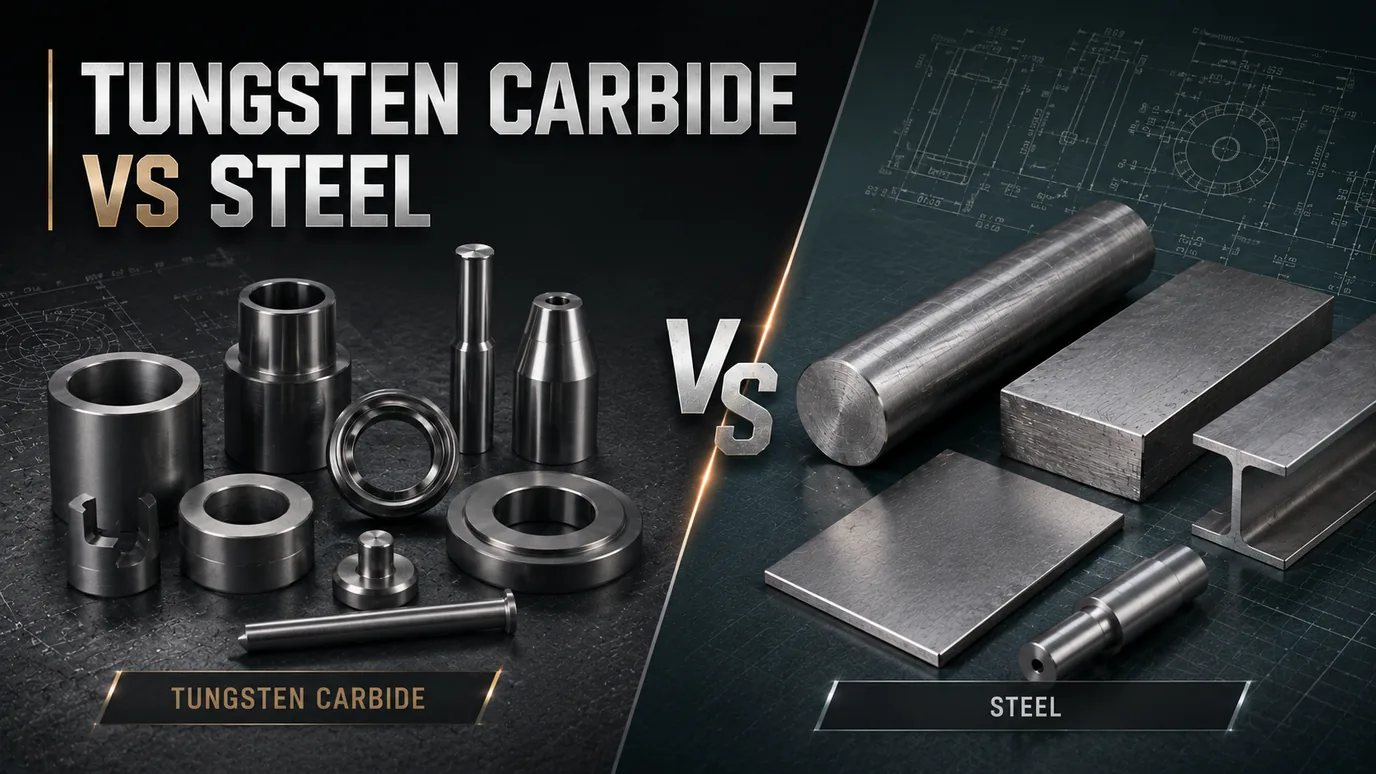
Tungsten carbide and steel are two of the most widely used materials in industrial manufacturing, but they behave very differently under stress, wear and heat. Choosing the wrong one can mean premature tool failure, costly downtime, or over-spending on a part that never needed a premium material. This guide breaks down how tungsten carbide compares to steel across the properties that matter most: hardness, wear resistance, toughness, density, heat and corrosion resistance, and cost, so you can confidently select the right material for your application.
What is tungsten carbide?
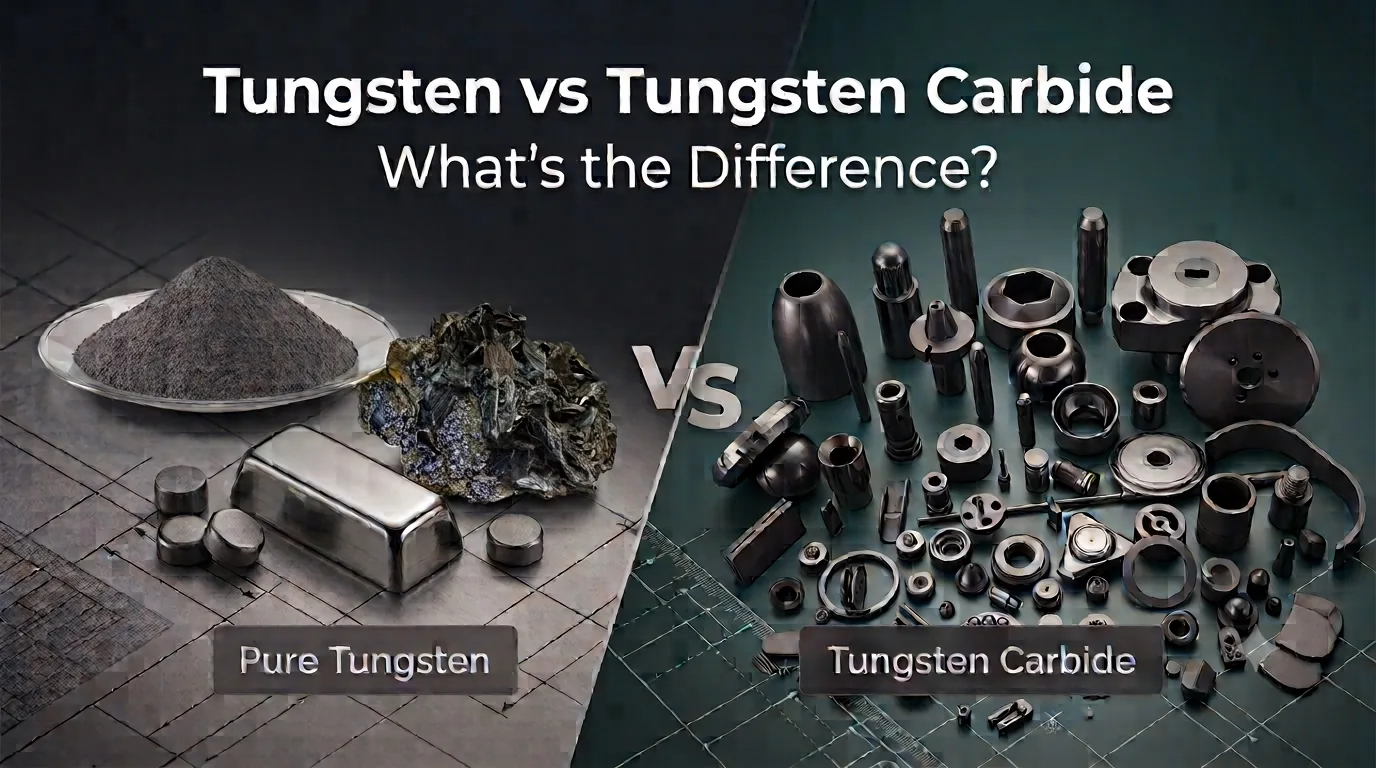
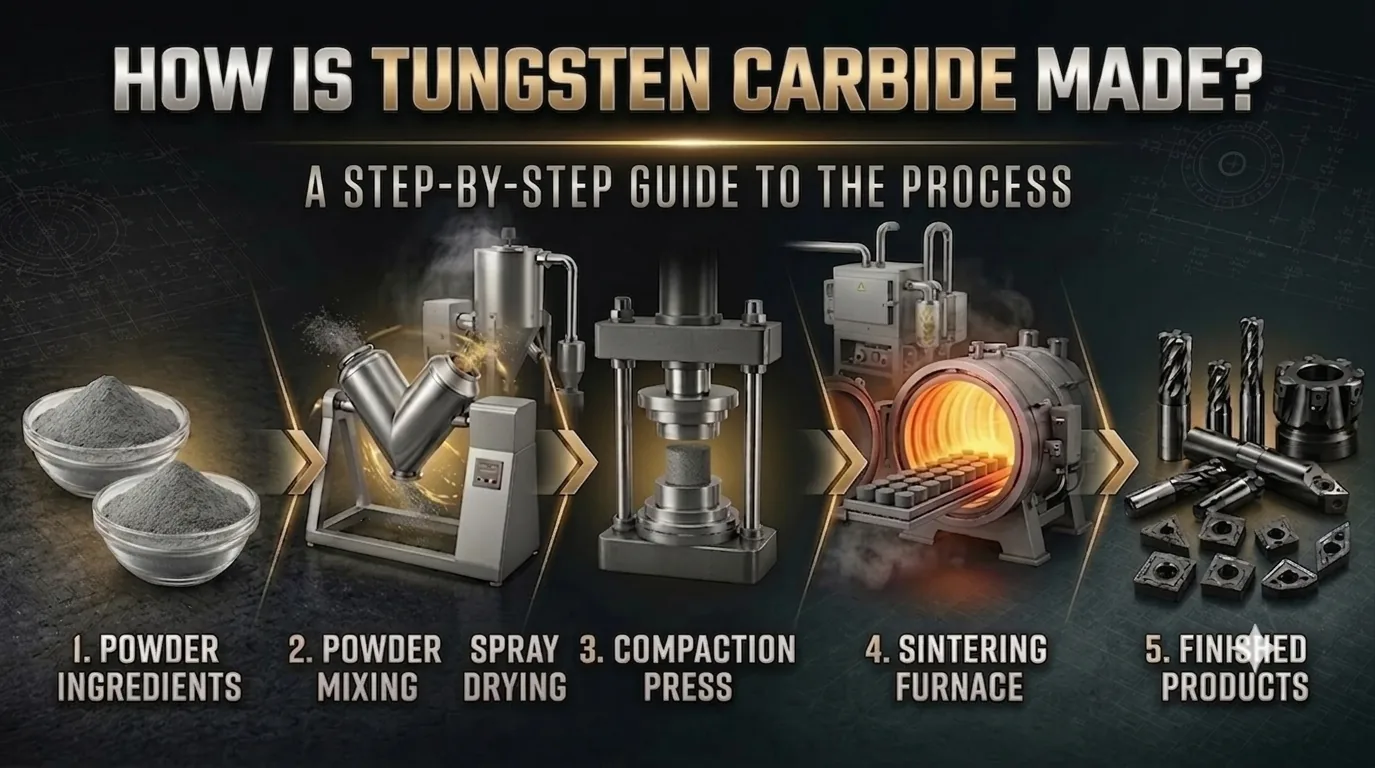
Tungsten carbide, often called cemented carbide, is a composite made by bonding hard tungsten carbide (WC) grains with a metallic binder, usually cobalt or nickel, through powder metallurgy and sintering. The result is an exceptionally hard, wear-resistant material used for cutting tools, dies, punches and wear parts that must hold their edge and dimensions far longer than steel. It should not be confused with pure tungsten metal, which is denser but far softer; our guide on tungsten vs tungsten carbide covers that distinction.
What is steel?
Steel is an alloy of iron and carbon, often with added elements such as chromium, nickel, molybdenum or vanadium that tune its strength, hardness, toughness and corrosion resistance. It ranges from soft, ductile mild steel to hardened tool steels and stainless grades. Steel is versatile, cost-effective, easy to machine and weld, and tough enough to absorb shock, which is why it remains the default material for most structural and general-purpose parts.
Tungsten carbide vs steel: quick comparison
Figures are typical ranges; exact values vary by grade, binder content and heat treatment.
| Property | Tungsten Carbide | Steel (hardened tool steel) |
|---|---|---|
| Hardness | 740–1500 HV | ~700–900 HV (46–65 HRC) |
| Wear resistance | Excellent | Moderate |
| Toughness / impact | Lower (more brittle) | Higher (more ductile) |
| Density | ~14.5–15.6 g/cm³ | ~7.8 g/cm³ |
| Stiffness (modulus) | ~530–650 GPa | ~200 GPa |
| Hot hardness | Holds hardness to ~1000 °C | Softens in tempering range |
| Corrosion resistance | Good (better with Ni binder) | Poor unless stainless |
| Machinability | Difficult (grind / EDM) | Easy (cut, weld, form) |
| Upfront cost | Higher | Lower |
| Service life in wear | Much longer | Shorter |
Hardness
Tungsten carbide is significantly harder than hardened steel. On the Vickers scale, tungsten carbide grades typically measure 740–1500 HV, compared with about 700–900 HV for tool steel, with the harder grades roughly twice the hardness of steel. Greater hardness means it resists scratching, indentation and edge rounding far better, keeping cutting edges sharper and parts dimensionally stable for longer.
Wear resistance
Hardness drives abrasion resistance. In high-wear environments such as machining, stamping, mining and oil & gas, tungsten carbide tools and wear parts can last many times longer than steel, dramatically reducing changeovers and downtime. This longevity is the single biggest reason manufacturers switch from steel to carbide in abrasive duty cycles.
Toughness and brittleness
This is steel’s advantage. Carbide’s hardness comes at the cost of toughness: it is more brittle and can chip or crack under heavy impact or shock. Steel deforms and absorbs energy rather than shattering. For interrupted cuts, impact loads or parts that must flex, steel, or a tougher, higher-binder carbide grade, is the safer choice.
Density, weight and stiffness
Tungsten carbide is about twice as dense as steel (~14.5–15.6 vs ~7.8 g/cm³), making it ideal for counterweights and balance applications but heavier for large moving parts. Its elastic modulus is also roughly two to three times that of steel, so it deflects far less under load, which is critical for precision boring bars, dies and tooling where rigidity controls accuracy.
Heat and corrosion resistance
Carbide retains its hardness at high temperatures (up to ~1000 °C), enabling high-speed machining where steel tools would soften and fail. On corrosion, standard cobalt-bonded carbide performs reasonably, while nickel-bonded grades resist corrosive, food and marine environments even better. Plain steel rusts unless it is stainless.
Cost: upfront price vs cost per part
Tungsten carbide costs more upfront, but in abrasive, high-volume or precision applications its longer life lowers the total cost per part through fewer tool changes, less downtime and more consistent quality. For low-wear or low-volume parts, steel remains the economical choice. The right comparison is rarely the purchase price; it is the cost over the full service life of the part.
When to choose tungsten carbide
- High abrasion or wear, such as mining, drilling, stamping dies and wear parts
- Long tool life and minimal downtime in high-volume production
- Precision and dimensional stability, where tight tolerances and rigidity matter
- High-speed or high-temperature cutting
- Where total cost per part matters more than upfront price
When to choose steel
- Heavy impact or shock loading
- Complex shapes that need machining, welding or forming
- Lower-volume or low-wear parts where premium life is not required
- Tight upfront budgets
- Parts that must flex or absorb energy
Applications across industries
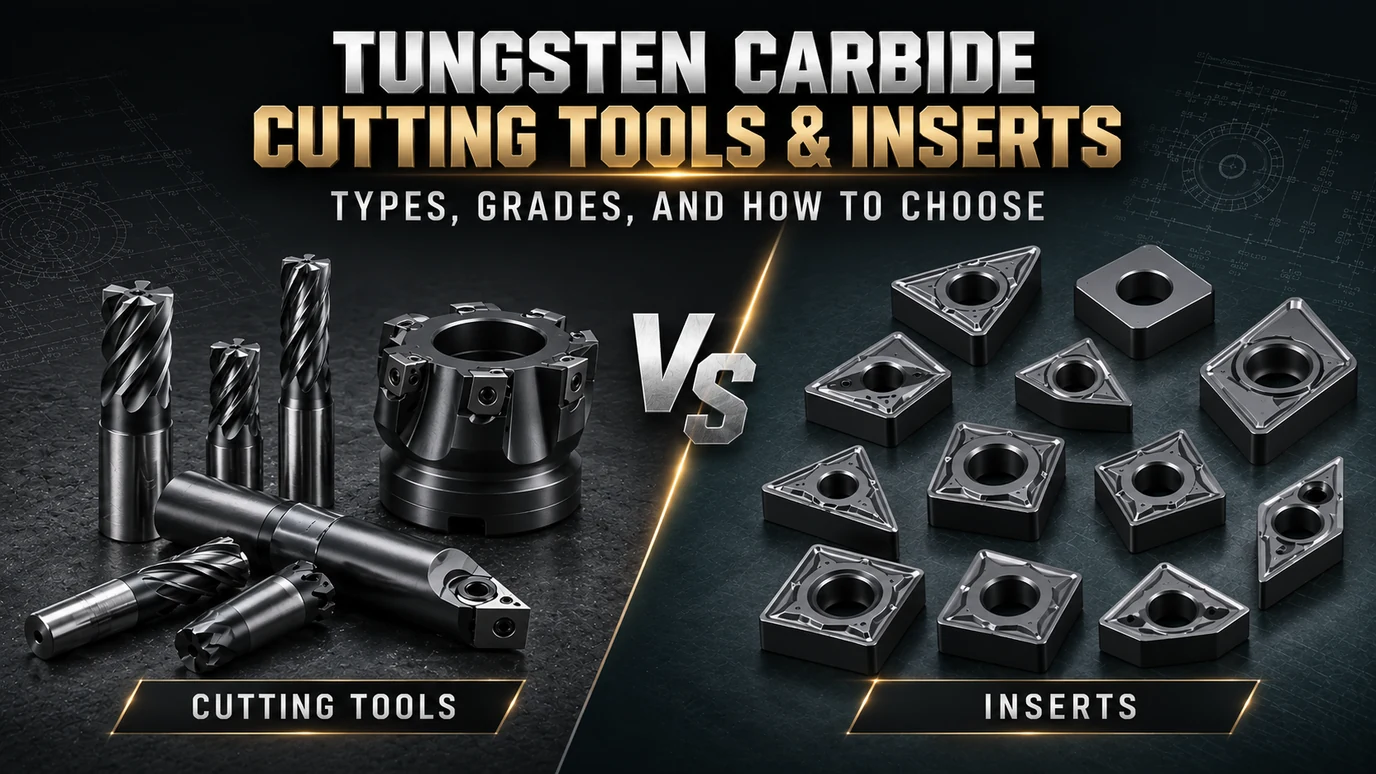
Around the world, manufacturers match the material to the duty cycle: cutting tools, wear parts, dies and punches, mining and drilling tips, oil & gas components, and metal-forming rolls. Many high-performance parts are hybrids, pairing a steel body with tungsten carbide tips or inserts, combining steel’s toughness and lower cost with carbide’s wear resistance for the best of both materials.
Conclusion
There is no universal winner. Tungsten carbide wins on hardness, wear, heat resistance and precision; steel wins on toughness, cost and workability. The best choice depends on your wear conditions, loads, tolerances and production volume. For metal cutting specifically, our guide to tungsten carbide cutting tools compares grades, coatings and geometry in depth. Sonani Tungsten manufactures and exports a full range of tungsten carbide grades and components to clients worldwide. Explore our tungsten carbide grades or contact our team to match the right grade to your application.