Tungsten carbide cutting tools do the work that high-speed steel cannot: holding a sharp edge at speed, under heat, through long production runs. For a machine shop the choice of carbide tool, grade, coating and geometry decides cycle time, surface finish and how often the machine stops for a tool change. This guide covers the main types of tungsten carbide cutting tools and inserts, how grain size and cobalt content change tool behaviour, what the ISO grade letters mean, which coatings suit which job, and how to match a tool to your material and operation.
Why Tungsten Carbide for Cutting Tools?
Three properties make carbide the standard cutting material. First, hardness: carbide resists the abrasion that rounds a cutting edge, so the tool holds its geometry far longer than steel. Second, hot hardness: carbide keeps that hardness at the temperatures generated in the cutting zone, where high-speed steel softens and fails. Third, stiffness: carbide deflects very little under cutting load, which is what allows tight tolerances and a clean surface finish. Together these enable faster cutting speeds, fewer tool changes and a lower cost per part. For a fuller comparison of the two materials, see our guide on tungsten carbide vs steel.
Types of Tungsten Carbide Cutting Tools
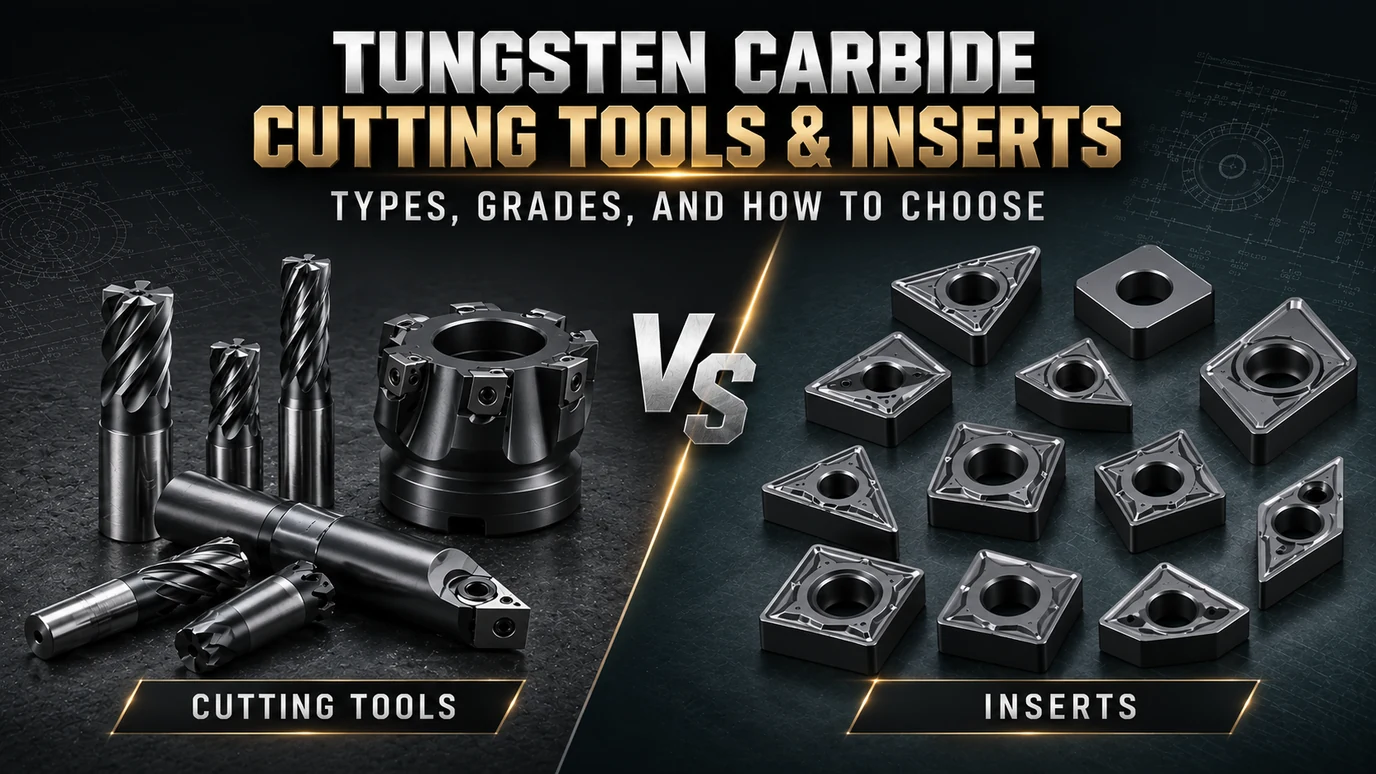
Carbide cutting tools fall into two broad families. Indexable tools carry a replaceable carbide insert in a steel holder, so only the insert is consumed. Solid carbide tools are ground entirely from carbide, which gives maximum rigidity in small diameters. The main types in production use are:
- Indexable carbide inserts. A precisely ground carbide tip clamped into a holder. When one edge dulls the insert is indexed to a fresh edge rather than reground, which is why indexable inserts dominate production turning, facing and boring.
- Solid carbide end mills. Used for profiling, slotting, pocketing and contouring. Available in square, ball nose and corner radius forms, and the most common solid carbide tool in CNC machining.
- Carbide drill bits. Solid carbide drills give precision hole-making with high penetration rates and long service life, holding size far better than high-speed steel in abrasive material.
- Carbide milling cutters. Face mills, shell mills and slot cutters that hold their geometry under heat and interrupted load for repeatable metal removal.
- Turning tools. Carbide turning tools deliver the dimensional accuracy and edge retention that automotive and aerospace parts demand.
- Carbide reamers. Used after drilling to bring a hole to its final size and finish. Carbide holds the reamed diameter across far more holes than steel.
- Carbide rotary burrs. Small shaped cutters used in die and mould work, deburring, weld dressing and finishing, typically run in a die grinder or robotic arm.
- Thread mills. Cut threads by helical interpolation rather than tapping, so one tool can produce several thread sizes and a broken tool is far easier to recover from than a broken tap.
- Countersinks and chamfer tools. Produce the seat for a screw head or break a sharp edge, often the last operation before inspection.
- Slitting cutters. Thin circular cutters for narrow slots and parting operations, where carbide resists the deflection that ruins slot width.
- Boring tools. Enlarge and finish an existing hole to close tolerance, usually with an indexable carbide insert in an adjustable head.
- T-slot cutters. Cut the undercut portion of a T-slot, a shape no end mill can reach.
- Woodworking cutting tools. Carbide tipped saw blades, router bits and planer knives, where abrasive board materials would destroy a steel edge quickly.
Sonani Tungsten manufactures carbide inserts, turning tools, milling cutters, drills, brazing tips, rotary burrs and broach cutters, and produces custom carbide cutting tools to customer drawings. If a tool is not on that list, send the drawing and our team will advise whether it can be produced.
Carbide Grain Size Explained
Grain size is the average diameter of the tungsten carbide particles held in the binder, measured in microns. It is the single strongest influence on how a cutting edge behaves. Finer grains pack more carbide into the same volume, which raises hardness and lets the edge be ground sharper, but leaves less room for the binder that absorbs shock. Coarser grains do the opposite. The recognised classes are:
| Class | Typical grain size | Behaviour and typical use |
|---|---|---|
| Nano grain | Below 0.2 microns | The hardest and sharpest edges available. Used for micro tools, precision electronics and very fine finishing where edge sharpness matters more than toughness. |
| Ultra-fine grain | 0.2 to 0.5 microns | Very high hardness with usable toughness. Common in micro end mills, PCB drills and medical device machining. |
| Fine grain | 0.5 to 1.0 micron | The mainstream metal cutting range. Best balance of hardness, edge retention and strength for inserts, drills and end mills. |
| Medium grain | 1.0 to 2.5 microns | Tougher and more shock tolerant. Suits interrupted cuts, heavier depths of cut and general purpose tooling. |
| Coarse grain | Above 2.5 microns | Maximum toughness and thermal shock resistance, lower hardness. Used for mining, rock drilling and heavy forming rather than precision cutting. |
The practical rule is that hardness and toughness pull in opposite directions. A finer grain gives longer life in a clean, continuous cut, and chips sooner if the cut is interrupted or the setup is not rigid. Sonani supplies fine-grain grades at 0.8 to 0.9 microns for metal cutting, and medium and coarse grades where impact resistance matters more.
Cobalt Content and How It Interacts With Grain Size
Cobalt is the metallic binder that holds the carbide grains together. More cobalt means more toughness and impact resistance but lower hardness and shorter life in abrasive cutting. Less cobalt means the reverse. Cutting grades usually sit between 6 and 12 percent cobalt, while forming and mining grades run much higher.
Grain size and cobalt content are chosen together, not separately. A fine grain with low cobalt is the hardest and most wear resistant combination and the most likely to chip. A coarser grain with high cobalt is the toughest and wears fastest. Most cutting grades are a deliberate compromise between the two, which is why two grades with the same cobalt percentage can behave very differently if their grain sizes differ.
ISO Carbide Grade Classification
The ISO system groups cutting grades by the material being machined rather than by composition, which is why the same letter appears across every manufacturer catalogue. The letter tells you the application group and the number that follows it indicates the balance between wear resistance and toughness: a lower number is harder and more wear resistant, a higher number is tougher.
| Group | Colour | Material machined | Typical characteristics |
|---|---|---|---|
| P | Blue | Steel, cast steel, long-chipping malleable iron | Resists crater wear and the high heat of long chips. Usually a titanium-rich grade. |
| M | Yellow | Stainless steel, austenitic and duplex, cast steel | Handles work hardening and built-up edge. Tougher than P for the same wear rating. |
| K | Red | Cast iron, chilled iron, short-chipping malleable iron | High abrasion resistance for short chips and abrasive graphite structures. |
| N | Green | Aluminium, copper, brass, other non-ferrous metals | Sharp edges and polished flutes to prevent the material sticking to the tool. |
| S | Brown | Heat resistant superalloys, nickel and titanium alloys | Built for high cutting temperatures and the notch wear these alloys cause. |
| H | Grey | Hardened steel, chilled cast iron, above about 45 HRC | Maximum hardness and hot hardness for hard turning and hard milling. |
These groups are an industry-wide classification, not a product range. Sonani grades are published with full composition, density, hardness (HV), transverse rupture strength and grain size on the tungsten carbide grades page, so a grade can be matched to an ISO group by its measured properties rather than by a marketing label.
Carbide Tool Coatings
A coating is a thin hard layer applied to a finished carbide tool. It does not change the carbide underneath: it adds surface hardness, reduces friction and insulates the substrate from cutting heat. Coatings are applied by one of two industry processes. PVD, physical vapour deposition, runs at around 400 to 500 degrees Celsius and produces a thin, sharp coating that suits precision tools and interrupted cuts. CVD, chemical vapour deposition, runs far hotter at around 800 to 1,000 degrees and produces a thicker, more wear resistant coating better suited to continuous turning of steel and cast iron. The common coatings are:
| Coating | Colour | Best suited to |
|---|---|---|
| TiN, titanium nitride | Gold | The original general purpose coating. Steel and cast iron at moderate speeds, and still used where cost matters more than maximum performance. |
| TiCN, titanium carbonitride | Blue grey | Harder than TiN with better abrasion resistance. Suits drilling, reaming and milling of steel and stainless at moderate temperature. |
| TiAlN, titanium aluminium nitride | Violet black | Forms a protective aluminium oxide layer as it heats, so it performs better as speed rises. The default for dry and high speed machining of steel. |
| AlTiN, aluminium titanium nitride | Black | More aluminium than TiAlN, giving higher hot hardness again. Used for hardened steel and high temperature work. |
| AlCrN, aluminium chromium nitride | Blue grey | Excellent oxidation resistance and thermal stability. Suits difficult materials, heavy interrupted cuts and dry machining. |
| DLC, diamond-like carbon | Dark grey | Very low friction. Used on non-ferrous work such as aluminium, copper and graphite, where material sticking to the edge is the main failure mode. Not used on steel. |
When to use a coated tool: high cutting speeds, dry or minimum-quantity lubrication, abrasive or hardened materials, long production runs, and anywhere heat is the limiting factor. A coating typically multiplies tool life several times over in these conditions.
When an uncoated tool is the better choice: machining aluminium and other soft non-ferrous metals where a razor-sharp uncoated edge cuts more cleanly than a slightly rounded coated one, very low speed or manual work where heat never builds, small batch or prototype work where the coating cost is not recovered, and any application needing the sharpest possible edge, since every coating adds a few microns of radius.
Note for the reader: coatings are an industry topic covered here for completeness. Sonani Tungsten manufactures the carbide substrate, and coating is a separate finishing process.
Tool Geometry and What Each Angle Does
Two tools in the same grade can perform very differently because of geometry. These are the features that matter most:
- Helix angle. The twist of the flute along an end mill or drill. A low helix, around 30 degrees, is stronger and suits harder materials. A high helix, 45 degrees and above, shears more freely and evacuates chips faster, which suits aluminium and deep slots.
- Rake angle. The angle the cutting face presents to the workpiece. A positive rake cuts more freely with lower cutting force and a weaker edge, good for soft and gummy materials. A negative rake is stronger and pushes rather than slices, which suits hardened material and interrupted cuts.
- Relief or clearance angle. The angle behind the cutting edge that stops the tool rubbing the surface it has just cut. Too little causes heat and rubbing; too much weakens the edge.
- Nose radius. On a turning insert, the rounding at the tip. A larger radius is stronger and gives a better finish at higher feed rates, but increases cutting forces and the tendency to chatter on slender parts.
- Corner radius. On an end mill, the rounding at the corner of the flute. It removes the sharp corner that normally chips first, extending tool life substantially in hard materials.
- Number of flutes. Fewer flutes, two or three, leave more room for chips and suit aluminium and deep slotting. More flutes, four to six and above, put more cutting edges in the cut for a better finish and higher feed rates in steel, but need shallower cuts so chips can escape.
Selecting the Right Carbide Cutting Tool
The table below is a practical starting point. Cutting speed and feed depend on the machine, the holder, the coolant and the rigidity of the setup, so treat these as a direction rather than a specification and confirm with your tooling supplier before committing a production run.
| Workpiece material | ISO group | Grain and cobalt | Coating | Cutting conditions |
|---|---|---|---|---|
| Carbon and alloy steel | P | Fine grain, 6 to 10% Co | TiAlN or TiCN | Moderate to high speed, medium feed, wet or dry, continuous cuts. |
| Stainless steel | M | Fine to medium grain, 8 to 12% Co | TiAlN or AlCrN | Lower speed, higher feed, wet cutting preferred to control heat and work hardening. |
| Cast iron | K | Fine grain, 6 to 9% Co | TiAlN or uncoated | High speed, medium feed, usually dry because the graphite lubricates. |
| Aluminium | N | Ultra-fine to fine grain, 6% Co | DLC or uncoated polished | Very high speed, high feed, wet or air blast, high helix and few flutes. |
| Copper and brass | N | Fine grain, 6% Co | Uncoated polished | High speed, moderate feed. Sharp positive rake to stop material sticking. |
| Titanium alloys | S | Fine grain, 6 to 10% Co | AlCrN or TiAlN | Low speed, steady feed, flood coolant essential. Never dwell in the cut. |
| Nickel alloys, Inconel | S | Fine grain, 6 to 10% Co | AlCrN or AlTiN | Low speed, high pressure coolant, rigid setup. Expect notch wear. |
| Hardened steel, 45 HRC and up | H | Ultra-fine to fine grain, low Co | AlTiN or AlCrN | Low to moderate speed, light depth of cut, usually dry, negative rake and corner radius. |
Two conditions from the table deserve emphasis. Interrupted cutting, meaning a milling cut or a turned bar with a keyway or cross hole, needs a tougher grade with more cobalt, because every entry into the material is an impact. Dry machining puts all the thermal load on the tool, so it needs a coating built for hot hardness such as TiAlN, AlTiN or AlCrN. Wet machining removes heat but introduces thermal cycling on every rotation, which favours a coating and a grade with good thermal shock resistance.
Industries That Depend on Carbide Cutting Tools
Carbide tooling appears wherever tight tolerances, hard materials or long production runs make steel tools uneconomic:
- Automotive. Engine blocks, transmission components, brake parts and fasteners, in high volume where cycle time and consistency decide cost.
- Aerospace. Titanium and nickel superalloy structural parts, where cutting conditions are punishing and every part is inspected.
- Medical. Implants and instruments in stainless and titanium, requiring fine finishes and micro tools.
- Oil and gas. Valve bodies, flow control components and downhole parts in hard, corrosion resistant alloys.
- Die and mould. Cavity and core machining in hardened tool steel, including hard milling with small corner radius tools and rotary burrs for finishing.
- Woodworking. Carbide tipped saw blades, router bits and planer knives for abrasive engineered boards.
- Mining. Drill bits, buttons and picks, using tough coarse-grain grades rather than fine cutting grades.
- General engineering. Job shops and tool rooms machining a different material every week, where versatile mid-range grades earn their place.
Custom Carbide Cutting Tools, Made and Exported Worldwide
As a tungsten carbide manufacturer based in Surat, India, Sonani Tungsten produces carbide inserts, turning tools, milling cutters, drills, brazing tips, rotary burrs and broach cutters to your drawings and specifications, and exports worldwide. Our quality management system is certified to ISO 9001:2015, covering the manufacturing of tungsten carbide powders, sintered parts and finished wear parts, and every grade is verified for composition, density, hardness and transverse rupture strength before it ships. Explore our cutting tools range or contact our team to match a grade to your operation.