If you have ever compared two carbide suppliers and found the same part offered in a different "grade", you have met the single most important, and most misunderstood, decision in tungsten carbide: grade selection. Two components can look identical, share the same drawing and both be called "tungsten carbide", yet one lasts for years while the other chips on its first shift. The difference is almost always the grade: the exact recipe of binder metal and carbide grain size that sets the hardness, toughness, wear resistance and strength of the finished part.
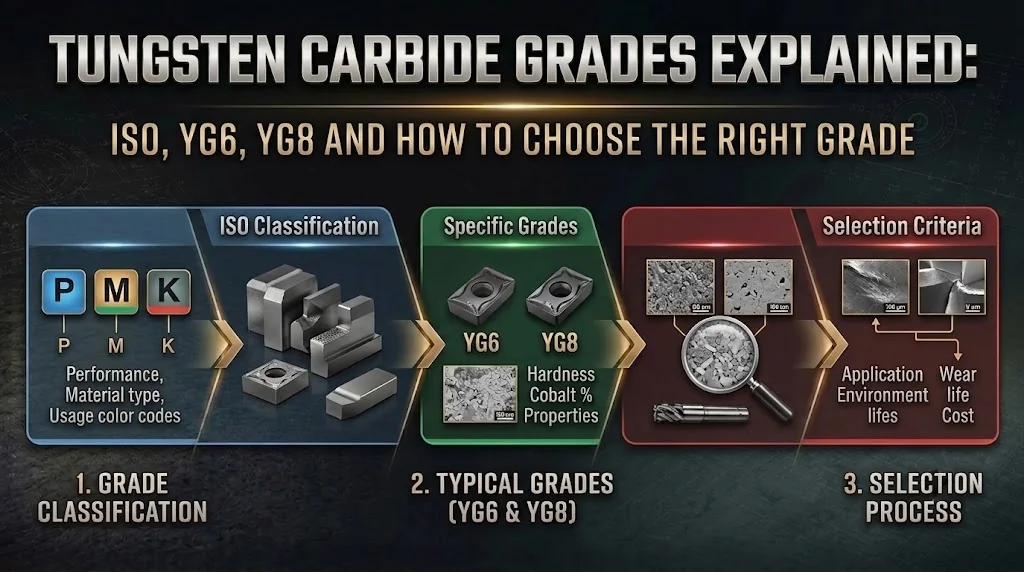
This guide explains the properties on a grade datasheet, the two levers that control every grade, the ISO, ANSI and YG classification systems (including YG6 vs YG8), and a practical method for choosing the right cemented carbide grade for a cutting tool, a forming die, a wear part or a mining insert.
What Is a Tungsten Carbide Grade?
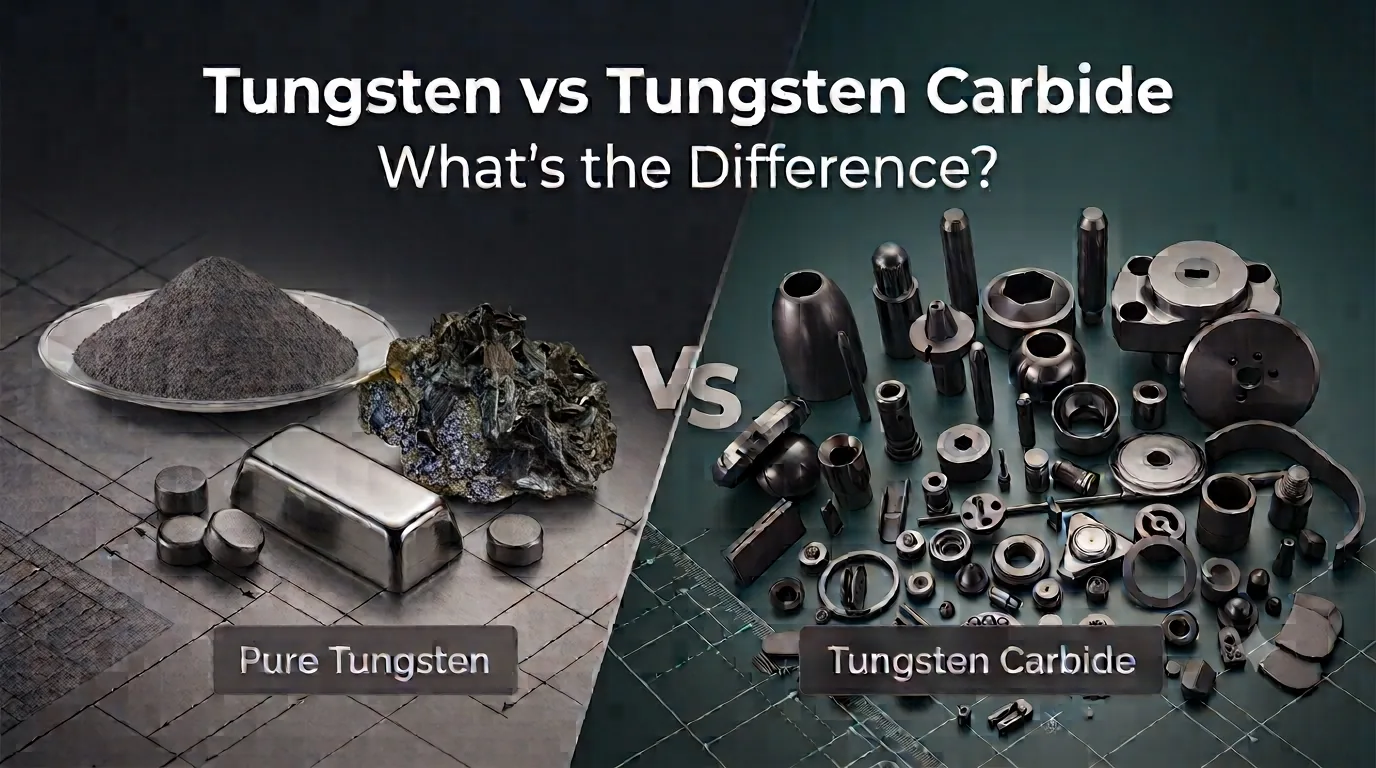
Tungsten carbide parts are almost never made from pure tungsten carbide, which is extremely hard but far too brittle to use on its own. Instead, hard tungsten carbide (WC) grains are cemented together with a tougher metallic binder, usually cobalt, to form a composite called cemented carbide, or hardmetal. If that idea is new, our guide to tungsten versus tungsten carbide explains the difference in detail.
A grade is a specific, repeatable version of that composite, defined by three things: the binder metal and its percentage, the average carbide grain size, and any small additives such as grain-growth inhibitors. Change any one of them and you change how the finished part behaves. Steel is the same idea: "steel" could be a soft mild steel or a hardened tool steel, and only the grade tells you which.
The Properties That Define a Grade (and How to Read a Datasheet)
Five or six numbers describe almost every grade, and each one measures a specific behaviour.
| Property | What it measures | Unit | A higher value means |
|---|---|---|---|
| Hardness | Resistance to permanent indentation; in service it correlates closely with abrasive wear resistance | HV (Vickers) or HRA (Rockwell A) | Harder and more wear resistant, but usually more brittle |
| Transverse rupture strength (TRS) | The bending stress a standard sample withstands before it breaks, from a 3-point bend test (ASTM B406 / ISO 3327) | N/mm² (equal to MPa) | Stronger in bending and more resistant to breaking under load |
| Fracture toughness (K1c) | Resistance to an existing crack spreading through the material | MPa·m½ | Tougher: more resistant to chipping and cracking under impact |
| Density | Mass per unit volume; an indicator of composition and of sound, pore-free sintering | g/cm³ | Usually less binder (more tungsten carbide); an in-range value confirms full sintering |
| Grain size | The average diameter of the tungsten carbide grains | micron (µm) | Coarser and tougher (a smaller number means finer and harder) |
| Binder content | The percentage of cobalt or nickel binder, by weight | weight % | Tougher and more impact resistant, but softer and less wear resistant |
Carbide hardness is reported on two scales: Vickers (HV) and Rockwell A (HRA). On both, a higher number means a harder material, but there is no exact, standardised conversion between them at the very high hardness of cemented carbide, so the safest practice is to compare grades on a single scale. Sonani specifies hardness in HV, while many YG datasheets use HRA. For toughness, most datasheets, including ours, list transverse rupture strength (TRS).
The Two Levers That Define Every Grade
Behind all those numbers, just two variables do most of the work: how much binder the grade contains, and how large its carbide grains are. Master these two levers and you can read any grade chart with confidence.
Lever 1: Binder content (usually cobalt)
The binder is the tough metal that wets and bonds the hard carbide grains together during sintering. Most grades use cobalt, typically from about 6 percent up to 25 percent or more by weight, because it bonds to tungsten carbide exceptionally well.
The rule is simple and never breaks: more binder means more toughness and impact resistance but lower hardness and wear resistance; less binder means higher hardness and wear resistance but greater brittleness. With more cobalt, the metal layer between the carbide grains (its "mean free path") is thicker, so the material can flex and absorb energy before a crack forms. A 6 percent cobalt grade is hard and wear resistant for wire drawing and cutting; a 25 percent cobalt grade is tough enough for fastener heading dies that take repeated hammering.
The binder metal matters as much as the amount. Cobalt gives the best all-round bond and is the default. Nickel is used instead where corrosion resistance is required, for example seal rings, pump parts and wear components in food, chemical and oil & gas service, because nickel-binder grades resist acids and moisture far better than cobalt, at a small cost in strength.
Lever 2: Carbide grain size
The second lever is the size of the tungsten carbide grains, which is set when the powder is produced and controlled during sintering (our guide on how tungsten carbide is made covers this stage). For the same binder content, finer grains give higher hardness and a sharper, longer-lasting edge, while coarser grains give more toughness and better resistance to impact and thermal shock. Submicron and ultra-fine grades are made possible by tiny additions of grain-growth inhibitors such as vanadium or chromium carbide, which stop the grains coarsening during sintering.
| Grain-size class | Typical size | Character | Typical use |
|---|---|---|---|
| Ultra-fine / submicron | below ~0.8 micron | Highest hardness, keenest and most stable edge | Precision cutting, micro-drills, fine wear parts |
| Fine | ~0.8 to 1.3 micron | High hardness with good strength | Cutting inserts, wire drawing, shot blasting |
| Medium | ~1.3 to 2.5 micron | Balanced hardness and toughness | General wear parts, forming and coining dies |
| Coarse | ~2.5 to 6 micron | Higher toughness and impact resistance | Mining buttons, rock-drilling inserts |
| Extra-coarse | above ~6 micron | Maximum impact and fatigue resistance | Heavy rock drilling, road milling, stamping |
Because binder and grain size both influence the same two properties, two grades with the same cobalt percentage can perform very differently. That is why a proper specification always states both the binder content and the grain size, not just one of them.
The universal trade-off: hardness versus toughness
Every carbide grade is a deliberate compromise. Move toward hardness (less binder, finer grain) and the part resists abrasion longer but chips more easily. Move toward toughness (more binder, coarser grain) and the part survives impact but wears faster. There is no grade that is best at both, only the grade that is best for a specific duty, and every classification system below is just a different way of describing where a grade sits on this scale.
How Tungsten Carbide Grades Are Classified
There is no single worldwide standard for naming carbide grades, which is why the same material can appear under several codes. Three universal systems dominate, and it pays to recognise all three.
The ISO application system (P, M, K, N, S, H)
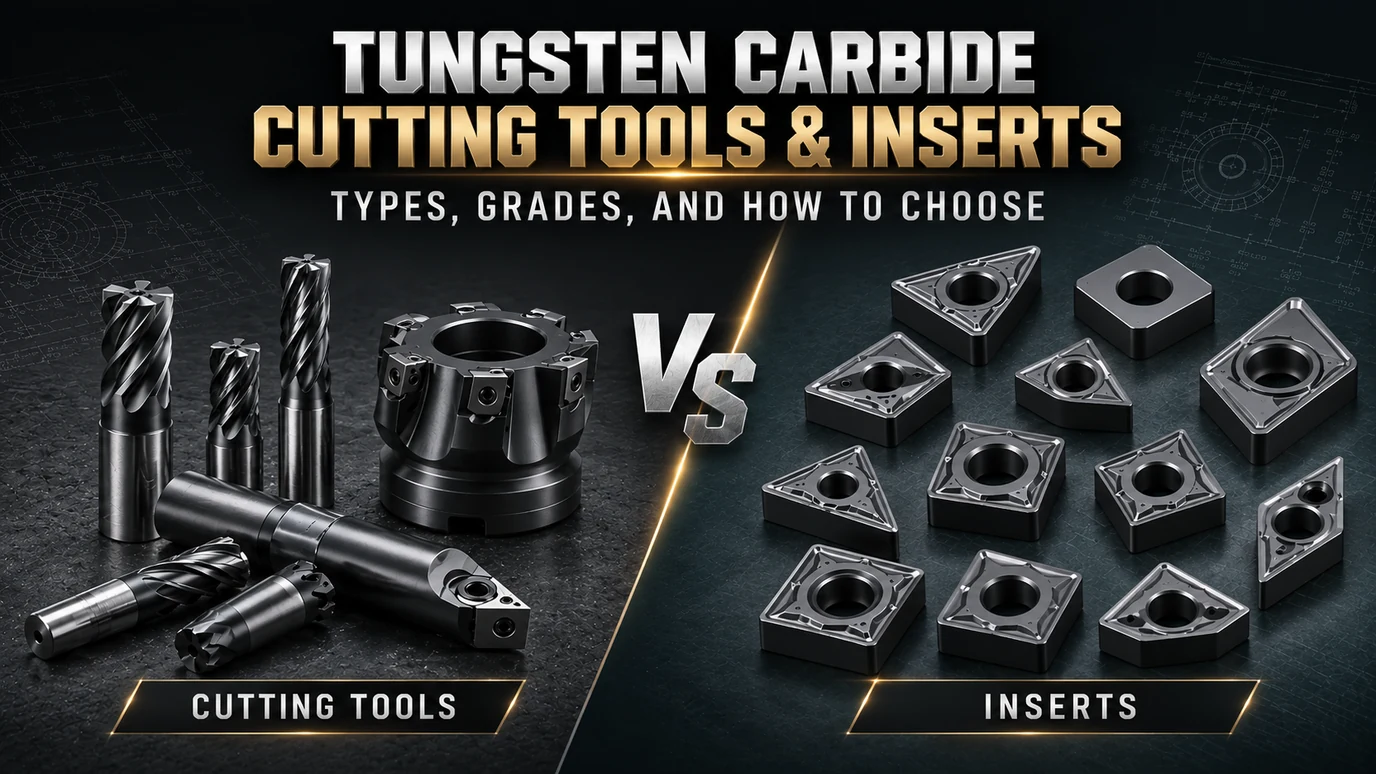
The most widely used system, defined in ISO 513, groups grades by the material they are designed to machine. Each group has a standard letter and colour. It was created for cutting tools; our guide to carbide cutting tools and inserts covers machining grades in more depth.
| ISO group | Colour | Material machined | Character |
|---|---|---|---|
| P | Blue | Steel (long-chip) | General machining group for carbon and alloy steels |
| M | Yellow | Stainless steel | Universal grades for stainless and difficult, work-hardening alloys |
| K | Red | Cast iron (short-chip) | Harder, wear-resistant grades for grey and ductile cast iron |
| N | Green | Non-ferrous: aluminium, copper, brass | Sharp, fine-grain grades for soft non-ferrous metals |
| S | Brown | Superalloys and titanium | Heat-resistant grades for nickel, cobalt and titanium alloys |
| H | Grey | Hardened steel | The hardest grades, for hardened and chilled materials |
The number after the letter, running from about 01 to 50, describes the hardness-to-toughness balance. A low number (for example P10 or K10) is a harder, more wear-resistant grade for finishing cuts and high speeds; a high number (P40, K30) is a tougher grade for roughing, interrupted cuts and lower speeds. The letter tells you the workpiece and the number tells you the balance.
The ANSI C-system
Common in North America, the older ANSI C-system runs from C1 to C8 for machining. C1 to C4 cover cast iron and non-ferrous work (roughly the ISO K group) and C5 to C8 cover steel (roughly the ISO P group); in each range, hardness rises with the number, from roughing to precision finishing. Higher designations (C9 and above) are sometimes used for wear and impact grades. Treat any C-to-ISO conversion as a starting point, not an exact equivalence.
The Chinese GB system: YG, YT and YN
Many carbide blanks and wear parts are sold under the Chinese GB national-standard codes, which tell you the composition directly. YG means tungsten carbide with a cobalt binder, and the number is the cobalt percentage: YG6 is 6 percent cobalt, YG8 is 8 percent, YG15 is 15 percent. An "X" suffix, as in YG6X, means a fine-grain version of the same composition, which is harder than the standard grade. YT grades add titanium carbide (WC-TiC-Co) for machining steel, roughly matching the ISO P group, and YN grades use a nickel binder for corrosion resistance. For wear parts and dies, the YG series is the one you will meet most often.
An approximate cross-reference
Because the systems were created independently, there is no exact conversion between them. Use this table to orient yourself, then confirm the actual properties on a datasheet.
| Character (hardness / toughness) | ISO (approx.) | ANSI C | YG (approx.) | Sonani family |
|---|---|---|---|---|
| Very hard, fine, wear-first | K10 / P10 | C4 / C8 | YG6, YG6X | SCF06, SCW06 |
| General purpose, balanced | K20 / P20 / M20 | C2 / C6 | YG8 | SCK06, SCF10 |
| Tougher, for roughing / impact | K30 / P30 | C1 / C5 | YG11, YG15 | SCW11, SCW15 |
| Very tough, for forming dies | beyond machining range | wear grades | YG20, YG25 | SCW25 |
| Corrosion resistant (nickel) | not covered by ISO | not covered | YN series | SCN06, SCN10, SCN27 |
Reading down the table, binder rises, grain often coarsens, hardness falls and toughness climbs, in every system.
YG6 vs YG8: The Most Common Grade Question
Because YG6 and YG8 are the two most widely stocked general-purpose grades, buyers ask about them constantly. YG6 has less cobalt, so it is harder and more wear resistant; YG8 has more cobalt, so it is tougher and better at absorbing impact. Neither is "better"; they sit two steps apart on the same trade-off.
| Grade | WC / binder | Hardness (approx.) | Toughness | Best suited to |
|---|---|---|---|---|
| YG6 | 94% WC / 6% Co | HRA ~89.5-91.5 | Lower | Finishing, low-impact wear, wire drawing, cast-iron and non-ferrous cutting |
| YG6X | 94% WC / 6% Co, fine grain | HRA ~91-92.5 (hardest here) | Low-medium | Fine finishing and precision wear where extra hardness is needed |
| YG8 | 92% WC / 8% Co | HRA ~89-90.5 | Higher | General-purpose and roughing, interrupted cuts, drilling inserts, heavier wear |
| YG15 | 85% WC / 15% Co | Lower | High | Forming and drawing dies, stamping, high-impact tooling |
| YG20 | 80% WC / 20% Co | Lowest here | Very high | Cold-heading and stamping dies that take heavy repeated shock |
In practice: choose YG6 when wear resistance and a fine finish matter most and impact is low; step up to YG8 when the tool sees shock, interruption or vibration. If you need still more toughness for a forming die, move up to YG15 or YG20, accepting lower hardness in return. On Sonani grades, a low-cobalt SCW06 or fine-grain SCF06 sits at the hard, wear-first end (YG6 territory), while a high-cobalt SCW25 sits at the very tough forming-die end (beyond YG20).
Cutting-Tool Grades Are Not the Whole Story
Most grade guides stop at the ISO machining system, but a large share of all tungsten carbide never cuts metal at all. Wear parts, forming and drawing dies, mining buttons, fastener tooling and oil & gas components are chosen by a different logic: not by the material being machined, but by the type of wear the part must survive.
- Abrasive wear (sliding grit, wire, powder, rock fines): favour a harder, lower-cobalt, finer-grain grade for maximum wear life.
- Impact and shock (rock drilling, cold heading, stamping): favour a tougher, higher-cobalt, coarser-grain grade that resists fracture.
- Erosion (high-velocity fluids and slurries, as in nozzles and flow control): favour a hard, fine-grain grade, and a corrosion-resistant binder if the fluid is aggressive.
- Corrosion and moisture (food, chemical, oil & gas): favour a nickel-binder grade, which resists acids and moisture far better than cobalt.
- High compressive load (powder compaction dies): favour a medium-cobalt grade that balances compressive strength with dimensional stability.
How to Choose the Right Tungsten Carbide Grade
You do not need to memorise every code. A short, reliable process gets you to the right grade for almost any part.
- Define the duty. Identify what actually destroys the part in service (abrasion, impact, erosion, heat, corrosion, or a combination) and the real load, speed, temperature and environment. This single step decides most of the answer.
- Set the hardness-to-toughness balance. Mostly abrasion with little impact points to a low-cobalt, fine-grain grade; heavy impact points to a high-cobalt, coarser grade. Most parts sit between, so start in the middle and move toward whichever failure you actually see in service.
- Choose the binder metal. Use cobalt as the default. Switch to a nickel binder only when corrosion, moisture or food contact is a factor.
- Match to a grade, then validate. Confirm the properties on a datasheet and, for critical parts, run a sample trial. Share your real conditions with the manufacturer rather than only naming a code, because the same code can vary between suppliers.
Worked examples
A wire drawing die for steel wire faces almost pure abrasion at moderate load, with little impact, so a hard, low-cobalt grade such as SCW06 (or fine-grain SCF06 for the longest life) is the natural choice.
A fastener heading die takes heavy, repeated impact as it forms a bolt head cold. Hardness matters less than surviving shock, so a high-cobalt grade such as SCW25 (25 percent cobalt) gives the toughness needed to avoid cracking.
A pump seal ring for a food line combines sliding wear with a wet, food-contact environment where a cobalt binder could corrode, so a nickel-binder grade such as SCN06 is the better choice.
For other parts, this table is a quick starting point.
| Application | Main demand | Binder | Grain | Sonani grade example |
|---|---|---|---|---|
| Wire drawing dies, seals, nozzles, gauges | Abrasion resistance | Low Co (6%) | Fine to medium | SCW06, SCF06 |
| Cutting tools and inserts | Hardness + hot hardness | Low-med Co, fine | Fine | SCF06, SCF10, SCK06 |
| Metal-forming and coining dies | Toughness + strength | Med-high Co (11-15%) | Medium | SCW11, SCW15, SCF15 |
| Fastener / heading dies | Max impact toughness | High Co (25%) | Medium-coarse | SCW25 |
| Mining and rock-drilling tools | Impact + abrasion | Med Co (8-9%) | Coarse | SCR08, SCR09 |
| Oil & gas, food, corrosive wear | Corrosion + wear | Nickel binder | Fine to medium | SCN06, SCN10, SCN27, SCF15 |
| Powder compaction dies and core rods | Strength + stability | Med Co (11%) | Medium | SCW11 |
Sonani Tungsten Grades at a Glance
The table below shows representative Sonani Tungsten grades with their real specifications. Hardness is in Vickers (HV): a higher HV means a harder, more wear-resistant grade. All 14 production grades, with full composition, are on our tungsten carbide grades page.
| Grade | Binder | Density (g/cm³) | Hardness (HV) | TRS (N/mm²) | Grain (µm) | Typical application |
|---|---|---|---|---|---|---|
| SCF06 | 6% Co (fine) | 14.75-14.90 | 1700-1820 | 2400 | 0.8-0.9 | Wire drawing, metal cutting, shot blasting. |
| SCW06 | 6% Co | 14.85-15.10 | 1450-1585 | 2400 | 1.3-1.8 | Wire drawing dies, gauges, seals, valves, choke beans, flow cages, nozzles, wear pads. |
| SCK06 | 6% Co | 14.72-14.88 | 1470-1590 | 2400 | 1.5-1.9 | Broach cutters for bearings, rotary burrs, metal cutting. |
| SCR08 | 8% Co | 14.64-14.80 | 1200-1300 | 3000 | 2.4-2.8 | Mining buttons for rock drilling. |
| SCN06 | 6% Ni | 14.88-15.04 | 1300-1420 | 2400 | 1.1-1.4 | Wear parts for food and oil & gas, pump seal rings. |
| SCW25 | 25% Co | 13.00-13.25 | 740-860 | 3100 | 2.3-2.7 | Fastener manufacturing, can extrusion and swaging dies. |
| SCN27 | 27% Ni | 13.05-13.25 | 750-850 | 3100 | 1.5-1.9 | Stabilizer discs for the oil & gas industry. |
Reading across, the two levers are visible in the numbers. The low-cobalt, fine-grain SCF06 (up to 1,820 HV) is the hardest and most wear resistant. The high-binder SCW25 and SCN27 (near 740 to 860 HV) are the softest but the toughest, with the highest TRS. Density falls as binder rises, because cobalt and nickel are lighter than tungsten carbide, so density itself is a quick check on composition. And the nickel-binder SCN grades trade a little strength for the corrosion resistance that food and oil & gas service demands.
How Carbide Grades Are Verified
A grade on paper is only useful if the finished part actually meets it. Typical checks include density (a fast indicator of correct composition and full, pore-free sintering), hardness in HV, transverse rupture strength, grain size under a microscope, and porosity. Magnetic properties, such as coercivity and magnetic saturation, are also used as production checks because they correlate with grain size and with the carbon balance of the binder. Sonani verifies each grade against its specification under an ISO 9001:2015 quality system, so the grade you specify is the grade you receive, batch after batch.
Common Mistakes When Choosing a Grade
- Chasing hardness alone. The hardest grade is also the most brittle. If the part sees any impact, a slightly softer, tougher grade will usually last longer.
- Ignoring grain size. Two grades with the same cobalt percentage can behave very differently, so always specify both.
- Overlooking corrosion. Match the binder to the chemistry, not just the wear: a nickel-binder grade survives wet, acidic or food environments where cobalt can corrode.
- Over-specifying. Matched correctly, a cheaper grade can outlast an over-specified one and cost less.
- Copying a code instead of describing the duty. The same code can differ between makers, so tell the manufacturer your real operating conditions and confirm the properties on a datasheet.
Match the Grade to the Job with Your Manufacturer
Grade selection is where tungsten carbide is won or lost, and no chart can replace matching the grade to your exact duty cycle. A manufacturer that controls the full process in-house, from powder to finished part, can tune and hold a grade consistently and recommend the right one for your application.
Sonani Tungsten manufactures tungsten carbide wear parts, metal-forming dies, mining tools, cutting tools, fastener tooling and oil & gas components across cobalt and nickel-binder grades from roughly 740 to 1,820 HV, all made in-house in Surat, India, and exported worldwide. Explore our full grade chart or contact our team with your part and operating conditions, and we will recommend the right grade.